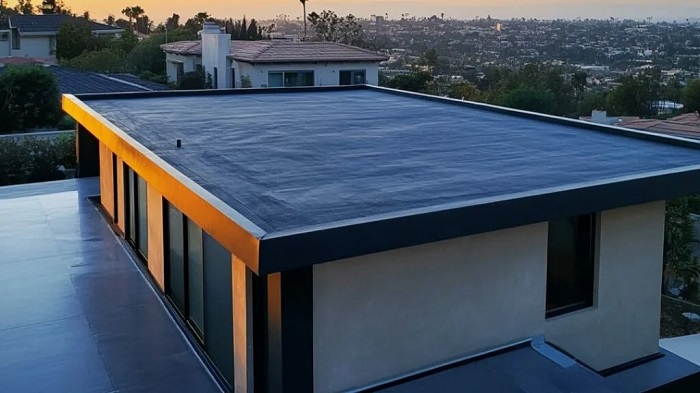
A flat roof is a type of roofing structure with a minimal slope, designed to direct water toward internal drainage outlets or external gutters. In practice, such a roof is not “perfectly flat”; a slope is typically created using screeds, tapered thermal insulation, or specialized sloped layers to prevent moisture from pooling.
Flat roof designs from roofing company are used in residential and commercial construction, as well as for industrial buildings, garages, and extensions. They are chosen when efficient geometry, compactness, the ability to house building services (such as HVAC equipment) on the roof, and ease of maintenance are priorities.
Concept and Types of Flat Roofs
A flat roof from roofing contractor is a multi-layered system in which each layer serves a specific function: supporting loads, providing thermal insulation, offering protection against moisture and ultraviolet (UV) radiation, and ensuring fire safety and long-term durability.
Main Types Based on Intended Use
- Non-accessible (non-trafficable) – designed primarily for maintenance and inspection purposes, without regular foot traffic or the placement of furniture.
- Accessible (trafficable) – designed for regular use, such as terraces, recreation areas, walkways, or platforms for equipment.
- Inverted (protected membrane) – a design where the waterproofing layer is placed beneath the thermal insulation, which consists of moisture-resistant material; this configuration provides superior protection for the waterproofing membrane against temperature fluctuations and mechanical damage.
Common Waterproofing Materials
- Bitumen-polymer roll membranes – reinforced materials that are either torch-applied or self-adhesive.
- Polymer membranes – such as PVC, TPO, or EPDM.
…are frequently used for large surface areas and are well-suited for mechanical fastening or seam welding.
- Liquid-applied (mastic) systems – seamless coatings that form a continuous waterproofing membrane, provided the substrate is properly prepared.
Summary: What Is a Flat Roof and How Should It Be Understood?
The definition of a flat roof consists from roofing contractors allentown pa of three components: slope geometry (how and where water is drained), structural characteristics (the layers and junctions that ensure watertightness and functional performance), and intended use (whether it is accessible/utilized or non-accessible, and whether it serves additional functions).
- Slope geometry is essential: even if a roof appears “flat,” it is designed with a slope—created by the substrate and/or a dedicated slope-forming layer—to prevent water from pooling.
- Structural characteristics are defined by the presence of a continuous substrate, thermal insulation (in “warm” roof assemblies), a vapor barrier (as determined by calculation), a waterproofing membrane, and junction details, all of which dictate the reliability of the entire system.
- Intended use influences the composition and sequence of the layers: an accessible (utilized) roof requires protective measures and load-distribution layers, whereas a non-accessible roof focuses on ease of maintenance and the durability of the roofing membrane.
- The functional performance of a flat roof is determined not by its name, but by the quality of its slopes, drainage, the sealing of junctions, and strict adherence to installation procedures.
- Final definition: A flat roof is a low-slope roofing system designed for controlled water drainage and specific operational loads, in which every layer and junction contributes to watertightness, thermal efficiency, and durability.